If you’ve been asking “is local SEO dead” because your rankings look fine but your phone isn’t ringing, you’re not imagining things. Something has genuinely changed in how local customers find businesses, and it isn’t happening on the search results page anymore.
In 2026, a plumber in Canberra, a boutique owner in Adelaide, and a real estate consultant in Perth are all fighting for visibility on surfaces that didn’t exist three years ago: Google’s AI Overviews, ChatGPT’s local recommendations, Perplexity’s cited answers, and Gemini’s business suggestions. Ranking #1 on a results page still matters, but it’s no longer the finish line.
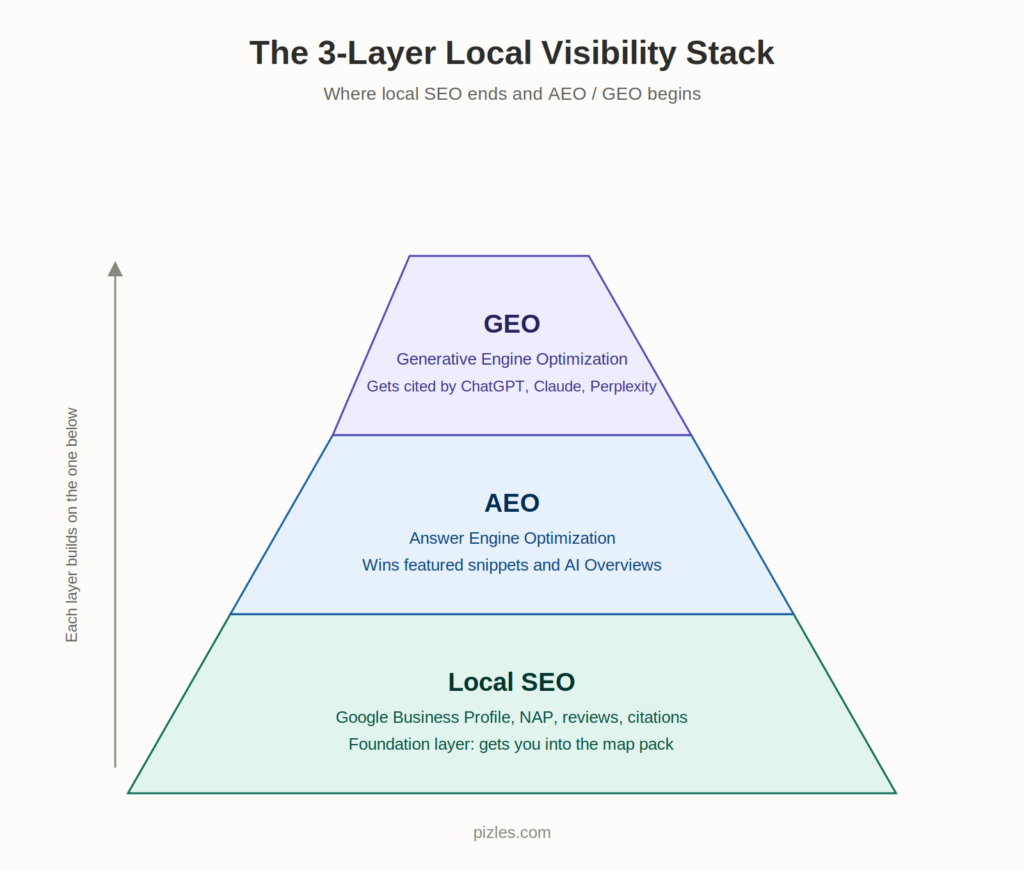
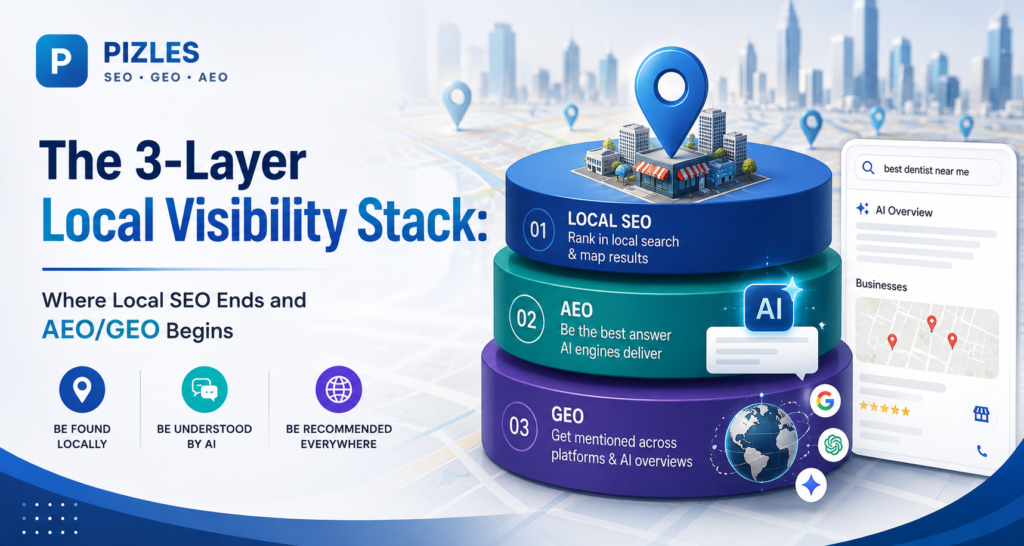
This is the idea behind the 3-layer local visibility stack: a framework for understanding where local SEO ends, where Answer Engine Optimization (AEO) takes over, and how Generative Engine Optimization (GEO) extends your reach into AI chat assistants entirely. If you only optimize for one layer, you’re invisible on the other two.
Let’s break down each layer, how they connect, and what to actually do about it, starting with the foundation that still holds everything else up.
What Is Local SEO, and Why It’s Still Layer One
Local SEO is the practice of optimizing your online presence so your business ranks in location-based searches: think Google Maps, the local 3-pack, and “[service] near me” queries. This remains the base layer of the stack because AI systems don’t invent local business information out of thin air. They pull it from the same signals that have always driven local rankings.
The core local SEO ranking factors haven’t disappeared in the AI-search era. They’ve just become the raw material that AEO and GEO build on top of:
- Google Business Profile (GBP) signals: primary category, proximity, and keyword-optimized business titles remain the single largest ranking factor in the local pack
- On-page signals: NAP (name, address, phone) consistency across your website and directories
- Review signals: volume, recency, and quality of customer reviews
- Link and citation signals: local backlinks and consistent directory listings
- Behavioral signals: clicks, calls, and direction requests from your listing
Here’s the part most business owners miss: if your local SEO foundation is weak, AEO and GEO have nothing to cite. AI Overviews and chatbot answers overwhelmingly pull from sources that already have organic visibility, so skipping straight to “AI optimization” without fixing your local SEO basics is like decorating a house with no foundation poured yet.
If your Google Business Profile, on-site local pages, or citations need work, this is exactly where our local SEO services and Google Business Profile optimization come in. It’s the groundwork every layer above depends on.
Layer Two: Where Answer Engine Optimization (AEO) Takes Over
Once your local SEO foundation is solid, the next layer is Answer Engine Optimization (AEO), and this is genuinely where most local businesses lose visibility today.
Here’s the mindset shift: traditional SEO asks “how do I rank for this keyword?” AEO asks “how do I become the direct answer to this question?” Search engines are no longer just returning a list of links. They’re extracting information and presenting it as a ready-made answer inside featured snippets, “People Also Ask” boxes, voice assistant responses, and AI Overviews.
This distinction matters enormously for local SEO vs AEO strategy. A keyword like “chartered accountant Delhi” is what you’d optimize a page title for under old-school SEO. But “how much does a CA charge for GST filing in Delhi?” is a question, and the second phrasing is what wins in an AEO-driven search landscape, because it matches how people actually type (and speak) into Google, ChatGPT, and voice assistants.
How to rank in Google AI Overviews and win AEO visibility:
- Answer questions directly, near the top of the page. Don’t bury the answer under three paragraphs of preamble. AI systems reward content that’s easy to lift out and reuse.
- Use question-based subheadings. H2s and H3s phrased as real questions (“How do I optimize Google Business Profile for AI search?”) give crawlers and language models a clear extraction point.
- Structure content with lists, steps, and short paragraphs. Clean visual hierarchy improves how accurately AI tools parse and reuse your content.
- Add schema markup. Structured data helps search engines and answer engines understand exactly what your content, and your business, actually is.
- Mine real questions. Pull from Google’s “People Also Ask,” AnswerThePublic, AlsoAsked, and even Reddit threads to find the natural-language questions your customers are actually asking.
The payoff is real: AI-driven search reduces casual browsing, but it increases high-intent leads. When your business becomes the answer instead of just a result, the people who find you tend to be further along and ready to book, not just window shopping.
If you’re not sure whether your site is technically capable of being extracted and cited this way, clean crawlability, fast load times, and proper indexing are worth auditing before anything else. Our technical SEO services fix the crawl, speed, and indexing issues that quietly block AEO visibility even when your content is good.
Layer Three: Generative Engine Optimization (GEO) and the AI Chat Frontier
The third and newest layer is Generative Engine Optimization (GEO), and this is where local SEO vs AEO vs GEO confusion tends to peak, because the three terms get used interchangeably even though they solve different problems.
Where AEO is about earning a spot inside Google’s own answer boxes, GEO focuses on how your content gets used, summarized, and cited by generative AI models like ChatGPT, Claude, Perplexity, and Gemini, often in conversations that never touch a traditional search engine at all. GEO is roughly 80% strategic (brand authority, ecosystem presence, being genuinely citation-worthy) and only 20% technical.
This raises a very practical, very current question for local business owners: does ChatGPT recommend local businesses? Increasingly, yes, and the sources it pulls from behave a lot like the sources that already rank well organically. One widely cited industry analysis found that over 92% of queries triggering an AI Overview cited at least one domain that also appeared in the organic top 10. That’s not a guarantee GEO is “just SEO with extra steps.” AI systems can and do cite sources that were never ranked for the original query, thanks to how they break a single question into multiple sub-searches behind the scenes. But it does confirm the core principle of the stack: organic strength is what gets you into the retrieval pool in the first place.
How to optimize for GEO as a local business:
- Publish original, factual, well-structured content. Generative models favor clear, citable information over vague marketing copy.
- Build topical authority around your services and locations. Not just one optimized page, but a consistent body of content.
- Get cited beyond your own website. Mentions on Reddit, LinkedIn, review platforms, and local publications feed the same ecosystem AI models draw from.
- Keep NAP and service details consistent everywhere. GEO models cross-reference multiple sources before trusting one.
If you’re a Shopify, WooCommerce, or Magento-based local retailer, GEO also extends to product-level visibility. AI shopping assistants are starting to recommend specific products alongside local businesses, which is where our AI SEO and Generative Engine Optimization services and ecommerce SEO services work together.
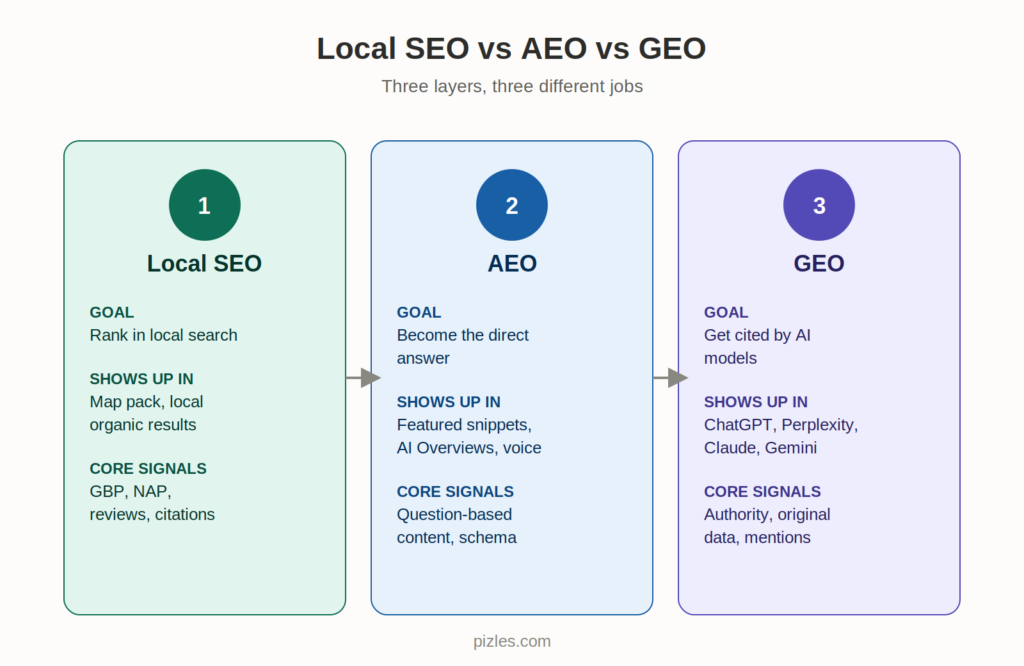
Local SEO vs AEO vs GEO: How the Three Layers Actually Work Together
It’s tempting to treat local SEO vs AEO vs GEO as three competing strategies you have to choose between. In practice, they’re sequential and cumulative: each layer depends on the one below it.
| Layer | Goal | Where You Show Up | Core Signals |
| Local SEO | Rank in local search | Map pack, local organic results | GBP, NAP, reviews, citations |
| AEO | Become the direct answer | Featured snippets, AI Overviews, voice results | Question-based content, schema, structure |
| GEO | Get cited by AI models | ChatGPT, Perplexity, Claude, Gemini answers | Authority, original data, cross-platform mentions |
None of these strategies replace the others. A business with excellent local SEO in 2026 but zero AEO structure will still lose visibility inside AI Overviews. A business chasing GEO trends without a functioning Google Business Profile is building on sand. The businesses winning right now are the ones executing on all three layers simultaneously, not the ones that “do SEO” in isolation.
Common Mistakes That Break the Stack
- Over-optimizing for keywords, under-optimizing for questions. Keyword density matters less than precision. AI systems reward content that clearly explains what you do, where you operate, and who you serve.
- Ignoring structured data. Skipping schema markup means your site isn’t “speaking the language” AI systems use to trust and extract information.
- Treating GEO as separate content. In most cases, you don’t need brand-new pages for AEO or GEO. You need to improve existing content with clearer answers, better structure, and stronger schema.
- Neglecting your CMS foundation. If you’re on WordPress, platform-level SEO hygiene still matters for crawlability across all three layers. See our WordPress SEO services if this is a gap.
Ready to Build Your Full Local Visibility Stack?
Ranking on page one used to be enough. In 2026, it’s just the entry ticket. If your business isn’t showing up when someone asks Google, ChatGPT, or Perplexity a direct question, you’re leaving high-intent, ready-to-book leads on the table for a competitor who is.
Pizles builds all three layers together: local SEO foundations, AEO-ready content structure, and GEO-focused authority building, so your business gets found whether someone types a query or asks an AI assistant out loud. Whether you’re based in Canberra, Perth, Adelaide, or anywhere else, we can audit exactly where your visibility stack is breaking down.
Get your free local visibility audit →
Talk to our team about a tailored local SEO, AEO, and GEO strategy. No generic package, just a plan built around what your business actually needs to show up as the answer, not just a result.
Frequently Asked Questions
What is the 3-layer local visibility stack?
The 3-layer local visibility stack is a framework describing how local businesses need to be optimized across three connected systems: local SEO (ranking in maps and local search), AEO (being selected as the direct answer in featured snippets and AI Overviews), and GEO (being cited by generative AI tools like ChatGPT, Perplexity, and Claude). Each layer builds on the one below it.
What is the difference between local SEO and AEO?
Local SEO focuses on ranking in location-based searches like the Google Map Pack, using signals such as Google Business Profile optimization, reviews, and citations. AEO (Answer Engine Optimization) focuses on being selected as the direct “answer” by AI-powered search features: featured snippets, voice assistant responses, and AI Overviews. Local SEO gets you into the pool of eligible results; AEO determines whether you get pulled out and shown as the answer.
Is local SEO dead in the age of AI search?
No. If anything, local SEO is the foundation everything else depends on. AI Overviews and generative engines still pull heavily from businesses that already rank well organically and have strong Google Business Profile signals. What’s changed is that ranking alone is no longer enough; you also need AEO structure and GEO authority layered on top.
How do I optimize my Google Business Profile for AI search?
Keep your primary category accurate, ensure NAP (name, address, phone) consistency across your website and every directory, actively collect and respond to reviews, and use natural, question-answering language in your business description and service listings. GBP signals remain the single largest local pack ranking factor, and AI systems reference this same data when generating answers.
How long does it take to see results from AEO and GEO optimization?
Results vary by industry and competition, but businesses typically see measurable improvements in AI visibility, such as appearing in AI Overviews or getting cited by chat assistants, within a few months of correctly optimizing content structure, schema, and business information. It’s faster when local SEO fundamentals are already solid.
Do I need separate content for AEO and GEO, or can I update existing pages?
In most cases, you don’t need entirely new pages. Improve your existing local service pages by adding clearer, question-based subheadings, direct answers near the top of each section, structured lists, and schema markup. Layering AEO and GEO improvements onto strong existing content is usually more effective than starting from scratch.
Does ChatGPT actually recommend local businesses?
Increasingly, yes. Generative AI tools tend to cite sources that already carry organic visibility and topical authority, cross-referenced against reviews, mentions, and consistent business information across the web. This is exactly why the local SEO foundation still matters even when the customer never opens Google.