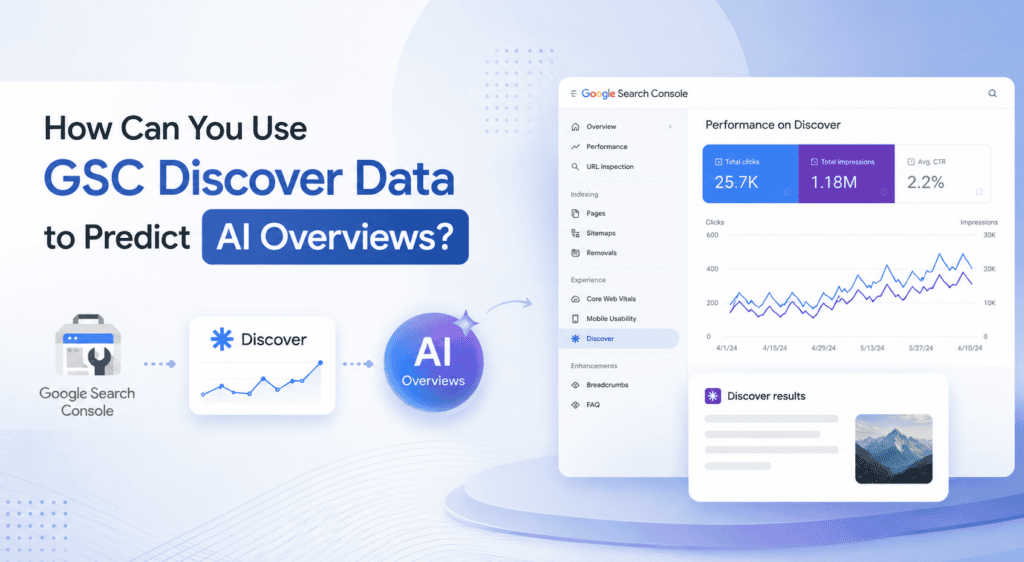
Most SEO teams still treat Google Discover and AI Overviews as two separate reporting problems. That’s a mistake. Since June 2026, Search Console’s Generative AI performance report has quietly made it possible to cross-reference the two, and the overlap is where the real signal lives. If a page is already being surfaced inside Discover’s generative AI features, it has effectively been pre-vetted by Google’s retrieval systems as citation-worthy content. That’s the earliest predictive signal you’ll get before a page shows up inside a standard AI Overview.
This guide walks through exactly how to pull that data, read it correctly, and turn it into a forward-looking content roadmap, not just a rearview-mirror report.
Why Does Discover Data Matter for AI Overview Prediction?
Discover and AI Overviews are built on overlapping retrieval logic, even though they render on different surfaces. Google’s own documentation confirms it now tracks generative AI features inside Discover using the same infrastructure as AI Overviews and AI Mode, impressions are logged any time a URL appears inside AI Overview, AI Mode, or AI-generated features in Discover, all sliced by Pages, Countries, Dates, and Devices in one unified report.
That shared plumbing is the opportunity. A page that Google’s generative layer already trusts enough to surface inside Discover is a page whose entities, structure, and freshness signals are already passing the same trust checks an AI Overview citation requires. Instead of guessing which of your pages might get pulled into a future Overview, you can look at which pages are already earning generative AI impressions in Discover and treat that as a leading indicator.
What Is the GSC Generative AI Performance Report and How Do You Access It?
The report sits inside Search Console’s Performance section as an expansion of the existing Search Type filter, previously limited to Web, Image, Video, and News, now including generative AI surfaces. It shows how often your URLs appear inside AI Overviews, AI Mode, and Discover’s AI-generated features, broken down by the same dimensions as the standard performance report: Pages, Queries (where available), Countries, Dates, and Devices.
A few technical quirks to know before you build a workflow around it:
- The chart aggregates at the property level by default, and switches to per-URL aggregation once you apply a specific page filter.
- Data follows the same 1,000-row export limit and Pacific Time aggregation as the standard performance report.
- The most recent days often show as a dotted line, this is preliminary data still being finalized, so don’t overreact to a single day’s spike or drop.
- An export button lets you pull the raw data into whatever reporting stack you already run.
If your property hasn’t received the rollout yet, it’s still expanding in stages, check back or filter your existing Performance report by “Web” search type as a partial workaround.
Which Discover Signals Actually Predict AI Overview Inclusion?
Not every page that gets Discover traffic is a future AI Overview candidate. Look for this specific pattern:
- Recurring generative AI impressions in Discover, not just standard Discover traffic. A page with normal Discover clicks but zero generative-feature impressions hasn’t cleared the same trust bar.
- Query-adjacent informational intent. Pages pulled into AI Overviews skew toward longer, conversational, research-oriented queries rather than short transactional ones, the same query shape that drives AI Mode.
- Freshness cadence. Google’s generative layers favor recently updated sources, so a page appearing in Discover’s AI features shortly after a content refresh is a stronger signal than one that hasn’t changed in a year.
- Entity clarity. Pages that are unambiguous about what they’re about, clear subject, clear scope, minimal topic-mixing, tend to get pulled more consistently across both surfaces because retrieval systems can match them to a narrower set of queries with confidence.
Treat pages meeting three or more of these as high-probability AI Overview candidates worth reinforcing rather than starting from scratch.
How Do You Build a Recurring Discover-to-AI Overview Prediction Workflow?
This isn’t a one-time audit, it needs to be a standing process, because AI surface visibility shifts as Google keeps expanding and refining these features.
- Pull the Generative AI performance report weekly, filtered to Discover, sorted by impressions.
- Cross-reference against your standard AI Overviews report to flag pages appearing in Discover’s AI features but not yet in AI Overviews, these are your prediction candidates.
- Check freshness and entity clarity on each candidate page using the criteria above.
- Reinforce, don’t rebuild, tighten the answer-first structure, add clear headings, and confirm the page’s core entity is stated unambiguously in the first 100 words.
- Re-check in 2 to 3 weeks to see whether the page has migrated into standard AI Overview impressions, and log the pattern for future prioritization.
What Should You Do Once a Page Shows the Signal?
Once a page is flagged as a strong Discover-to-Overview candidate, the fix is almost always structural rather than a rewrite:
- Lead the relevant section with a direct, self-contained answer before adding supporting detail.
- Make sure headings match the actual question a reader (or a retrieval system) would ask.
- Keep the page’s core topic singular, split off tangential subtopics into their own pages rather than diluting the one that’s already earning trust.
- Confirm crawl access isn’t blocked for AI crawlers and that internal links make the page easy to find from related content on your site.
If your team needs a second set of eyes on the technical side of this, crawl access, schema, and page speed all affect whether a trusted page keeps its visibility, our technical SEO services cover exactly this layer.
How Is This Different From Traditional AI Overview Optimization?
Most AI Overview advice is reactive: you find a page already appearing in Overviews and try to reverse-engineer why. The Discover-based approach flips that. You’re identifying pages Google’s generative systems have already started trusting, before they’ve shown up in the higher-visibility Overview surface, and reinforcing them while the opportunity is still open. It’s the difference between defending a citation you already have and building the next one before a competitor does.
This is also why Discover-based prediction pairs naturally with a broader generative engine optimization strategy rather than living as a standalone tactic, the entity structure, freshness signals, and answer-first formatting that help a page surface in Discover’s AI features are the same fundamentals that carry it into AI Overviews, AI Mode, and citations inside tools like ChatGPT and Perplexity.
Want This Data Working for You Instead of Sitting in a Report?
Reading the Generative AI performance report is one thing. Turning it into a prioritized, recurring content roadmap that actually grows your AI citations is another. Our team builds exactly this kind of workflow into every engagement, mapping entity clusters, auditing structured data, and reinforcing the pages already earning Google’s trust before your competitors notice the pattern.
Claim your free AI visibility audit and we’ll show you which of your pages are already showing the Discover-to-Overview signal, and what to fix first.
Frequently Asked Questions
1. What is the GSC Generative AI performance report?
It’s a Search Console report, rolled out starting June 2026, that isolates impressions your site earns inside AI Overviews, AI Mode, and generative AI features in Discover, separate from the standard Web search performance data.
2. Is Discover the same thing as AI Overviews?
No. Discover is a separate content feed shown in the Google app and mobile browser, while AI Overviews are AI-generated summaries shown directly on the search results page. They’re rendered differently, but Google now tracks generative AI activity across both using shared reporting infrastructure.
3. Can a page appear in Discover’s AI features without ever showing in a standard AI Overview?
Yes. That’s actually the useful case, a page earning generative AI impressions in Discover but not yet appearing in AI Overviews is a strong candidate to reinforce before it likely does.
4. Do I need special schema markup to appear in AI Overviews or Discover’s AI features?
No. Google’s own documentation confirms there’s no special schema.org markup or AI-specific file required. Standard SEO fundamentals, crawlability, clear content structure, and internal linking, remain the baseline requirement.
5. How often should I check the Generative AI performance report?
Weekly is a reasonable cadence for active content teams, since AI surface visibility can shift quickly as Google continues refining these features. Treat it as a recurring reporting item, not a one-off audit.
6. Why does the newest data in the report show as a dotted line?
That’s preliminary data still being finalized by Google. Avoid making decisions based on the last day or two of numbers, wait for the line to solidify before treating a spike or dip as real.
7. What does it mean if my property doesn’t have this report yet?
The rollout is staged and started with a subset of properties. If you don’t see it yet, keep checking, and in the meantime use the “Web” search type filter in your standard Performance report as a partial substitute.
8. Does higher Discover traffic always mean a page is AI-Overview-ready?
Not necessarily. Standard Discover clicks and generative AI impressions inside Discover are different metrics. A page can perform well in classic Discover without ever triggering the generative AI feature, it’s the generative impressions specifically that signal AI Overview readiness.
9. What’s the fastest fix for a page that’s showing the Discover-to-Overview signal?
Usually it’s structural: add a clear, direct answer near the top of the relevant section, tighten the headings to match real user questions, and make sure the page’s core topic isn’t diluted by tangents. Full rewrites are rarely necessary.
10. How does this fit into a broader AI SEO or GEO strategy?
Discover-to-Overview prediction is one input into a larger generative engine optimization approach, the same entity clarity, freshness, and answer-first structure that earn Discover’s AI trust also support citations across AI Mode, ChatGPT, and Perplexity. If you want this built into a full strategy rather than tracked manually, our AI SEO / GEO services are built around exactly this workflow.
Ready to turn your Search Console data into a predictive content roadmap instead of a historical report? Get in touch with our team and we’ll map your AI visibility gaps, free.