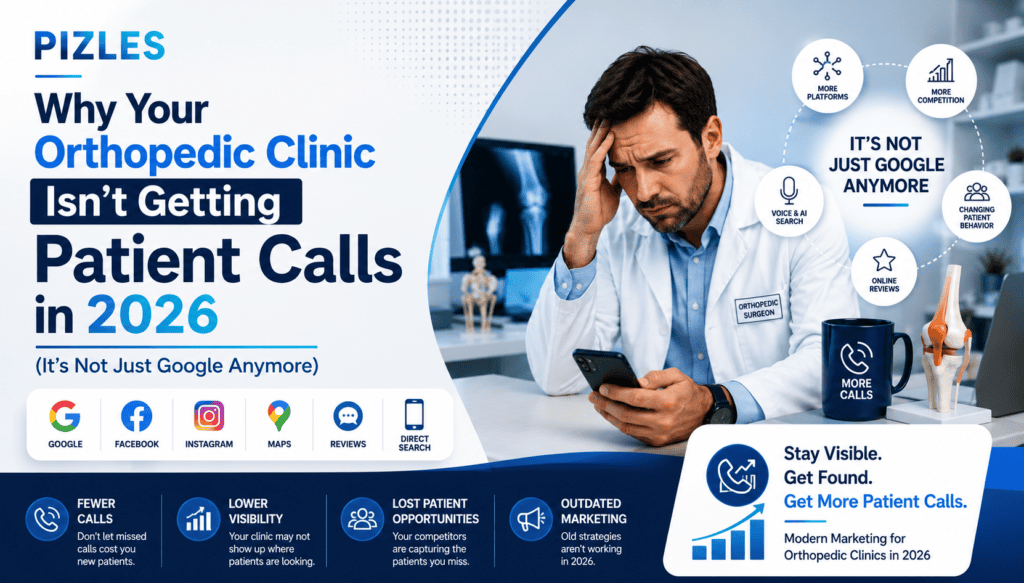
Most orthopedic clinics still optimize only for Google Maps and local pack rankings — but in 2026, a growing share of patients are asking ChatGPT, Google AI Overviews, and Perplexity “who’s the best orthopedic surgeon near me” before they ever open Google Maps. If your clinic isn’t structured for both, you’re losing patients to competitors who are.
You can be ranking on Google Maps and still not get the call. That disconnect is the single most common complaint we hear from orthopedic practices right now and it’s rarely about effort. It’s about optimizing for half the picture.
1. Why Orthopedic Clinics Struggle to Rank Locally in 2026 (And Why GMB Alone Isn’t Enough Anymore)
For years, “rank locally” meant one thing: optimize your Google Business Profile, collect reviews, get your NAP (name, address, phone) consistent across directories. That’s still necessary — but it’s no longer sufficient.
Here’s why clinics stall out even with a solid GMB listing:
- Service pages are too generic. A single page covering knee, hip, spine, and shoulder care gives Google (and AI engines) no signal about real depth in any one procedure.
- No procedure-specific content. Patients don’t just search “orthopedic surgeon near me” anymore — they search “ACL reconstruction surgeon Dallas” or “rotator cuff surgery specialist Houston.” A generic services page can’t compete for those high-intent terms.
- Hospital networks dominate generic keywords. You won’t out-rank a hospital system for broad terms by matching their content volume — you win by being more specific than they’re willing to be.
2. How Patients Actually Search Before Booking a Consult — Google, ChatGPT, and Everything Between
Roughly three out of four patients now research care online before ever calling a clinic — and a growing share of that research doesn’t start on Google at all. It starts with a direct question to an AI assistant: “who’s the best knee replacement specialist near me,” “should I see an orthopedic surgeon for shoulder pain,” “what does ACL surgery recovery look like.”
These questions used to lead to a page of blue links. Now, many of them get answered directly — with an AI Overview, a ChatGPT response, or a Perplexity summary that names specific clinics and specialists by name. If your practice isn’t structured to be pulled into that answer, you don’t just rank lower — you’re invisible in a channel that didn’t exist for local SEO five years ago.
3. Beyond Google Business Profile: The 5 Signals AI Overviews Actually Use to Recommend a Clinic
AI Overviews and chatbot answers don’t pull from your GMB listing the way local pack rankings do. They pull from a different, broader signal set:
- Structured data (schema markup) that clearly defines your practice, physicians, specialties, and procedures in machine-readable format
- Credentialed, procedure-specific content — pages written with named, board-certified surgeon authorship, not generic marketing copy
- Consistent entity signals across your website, GMB, medical directories, and review platforms — AI models cross-reference these to build confidence in who you are
- Patient review volume and recency — treated as a live trust signal, not a static rating
- Third-party citations — mentions and links from medical directories, local publications, and health authority sites that confirm your practice exists and is credible
Most clinics have #5 by accident (a directory listing here, a review there) and none of the rest deliberately. That gap is exactly where AI visibility is won or lost.
4. How to Rank (and Get Cited) for “Orthopedic Surgeon Near Me” in Competitive Texas Markets Houston, Dallas, Austin
Texas is one of the most competitive orthopedic markets in the country, and for good reason — major systems like Houston Methodist, Texas Health, and Baylor Scott & White dominate broad search terms in every major metro. Independent and multi-location practices can’t out-volume them. They can out-specific them.
Instead of chasing “orthopedic surgeon Houston” head-on, the stronger play is procedure- and neighborhood-level targeting: “minimally invasive spine surgery Katy TX,” “sports medicine specialist near Uptown Dallas,” “joint replacement surgeon North Austin.” These terms carry clearer intent, far less competition, and — critically — they’re the kind of specific, localized answer AI engines prefer to cite over a generic hospital page.
This same approach applies across San Antonio, Fort Worth, and any Texas metro where a handful of large systems currently soak up all the broad-term visibility.
5. Schema Markup for Orthopedic Practices: What Google and AI Search Engines Need to See to Trust You
Schema markup is the single most under-used technical asset in orthopedic SEO right now. At minimum, an orthopedic practice site should have:
- MedicalOrganization or MedicalClinic schema on the main site
- Physician schema for each surgeon, including credentials, board certifications, and specialties
- MedicalProcedure schema on individual procedure pages (ACL repair, joint replacement, spine surgery, etc.)
- FAQPage schema on service pages, since AI engines extract Q&A-formatted content directly
- Review / AggregateRating schema tied to real, verifiable patient reviews
This isn’t optional decoration — it’s the difference between Google and AI engines correctly understanding what your practice does versus guessing.
6. Why “Sports Medicine SEO” and “Orthopedic SEO” Aren’t the Same Strategy (And Why Mixing Them Costs You Patients)
These get treated as interchangeable constantly, and it costs clinics real patients. A sports medicine patient searching “knee pain while running” or “runner’s ACL injury recovery” is in a completely different mindset than someone searching “hip replacement recovery time.” They need different content, different keywords, and often a different landing page entirely.
Practices that blend both into one generic “orthopedics” service page lose both audiences — neither search intent gets a specific enough answer to convert. If your clinic offers both general orthopedic care and sports medicine, they need to be treated, and built, as two distinct content tracks.
7. Case Study: How We’d Rank and AI-Optimize a Multi-Location Orthopedic Group Across 3 Texas Cities
Take a hypothetical (but realistic) multi-location orthopedic group with clinics in Houston, Dallas, and Austin. The typical mistake: one homepage, one generic “our locations” page, and a handful of thin city pages that all say roughly the same thing.
The stronger structure:
- A dedicated page per city, each with locally relevant content — not duplicated copy with the city name swapped
- Procedure pages that cross-link to the nearest relevant location, so a Houston-based ACL page links to the Houston clinic specifically, not a generic contact page
- Physician bio pages with full schema markup, since named, credentialed authors are one of the strongest trust signals for both Google’s E-E-A-T standards and AI citation
- A shared FAQ library adapted per city, addressing local-specific questions (“does this location accept [regional insurer],” “what’s parking like at the Uptown Dallas clinic”)
The result of this structure isn’t just better rankings — it’s a site that AI engines can confidently cite for city-specific queries instead of defaulting to a hospital system’s generic page.
8. What to Do This Month If Your Clinic Gets Zero Calls From Google
If your phone isn’t ringing despite having a website and a GMB listing, start here:
- Audit whether AI crawlers can even access your site. Security plugins and hosting-level firewalls silently block GPTBot, ClaudeBot, and PerplexityBot more often than clinics realize.
- Check if you have any schema markup at all. Most orthopedic sites have none — this alone is often the biggest single gap.
- Look at your service pages. If one page tries to cover every procedure you offer, split it into dedicated, procedure-specific pages.
- Search your own practice name in ChatGPT and Perplexity. If you don’t come up with basic questions about your specialty and city, that’s your AI visibility gap made concrete.
- Get a real audit before spending on ads. Most clinics increase PPC spend to compensate for weak organic visibility — that’s treating the symptom, not the cause.
Get Your Clinic Found — On Google and in AI Search
At Pizles, we specialize in SEO and GEO built specifically for orthopedic and specialty medical practices not generic healthcare marketing templates. We build the schema, procedure-specific content, and AI-visibility structure that gets independent and multi-location orthopedic groups found ahead of hospital systems, both in Google’s local pack and inside AI Overviews, ChatGPT, and Perplexity answers.
We currently work with orthopedic and specialty clinics across Texas — including Houston, Dallas, Austin, San Antonio, and Fort Worth — as well as practices in other major US markets.
Get a free AI visibility audit for your clinic →
No generic packages — just a real audit of where your practice stands today, and a plan built around getting your phone to actually ring.
Frequently Asked Questions
1. Why isn’t my orthopedic clinic showing up on Google even with a good GMB profile?
A strong Google Business Profile helps with local pack rankings, but it doesn’t influence AI Overviews or chatbot answers on its own. Those rely on structured data, procedure-specific content, and consistent trust signals across your site and other credible sources.
2. What’s the difference between ranking on Google and being cited by AI Overviews or ChatGPT?
Ranking on Google means appearing in the list of search results. Being cited by AI means the AI engine directly names your practice in its answer — which requires clean schema markup, credentialed content, and clear entity signals, not just traditional keyword optimization.
3. Do I need separate pages for each procedure my clinic offers?
Yes. A single page covering knee, hip, spine, and shoulder care gives search engines and AI models no clear signal about your depth in any one area. Dedicated procedure pages consistently outperform combined service pages for high-intent searches.
4. Is “orthopedic surgeon near me” still a keyword worth targeting?
It’s still valuable but highly competitive, especially against hospital systems. Procedure- and neighborhood-specific terms like “ACL reconstruction surgeon [city]” or “joint replacement specialist [neighborhood]” often convert better with far less competition.
5. How long does it take to see results from orthopedic SEO?
Most practices see meaningful movement in 3–6 months, with stronger compounding results by month 6–12. AI citation visibility can sometimes move faster than traditional rankings once schema and structured content are in place.
6. What is schema markup, and does my clinic really need it?
Schema markup is structured code that tells search engines and AI models exactly what your practice, physicians, and procedures are. Most orthopedic sites have none at all, which makes it one of the fastest, highest-impact fixes available.
7. Can a multi-location practice avoid competing against itself in search results?
Yes, but only with a deliberate structure dedicated, non-duplicated content per location, procedure pages linked to the nearest relevant clinic, and location-specific FAQs, rather than one generic “locations” page.
8. Should sports medicine and general orthopedic services be marketed the same way?
No. Patients searching for sports medicine and those searching for general orthopedic care have different intent and different questions. Treating them as one blended service typically underperforms for both.
9. How do I know if AI crawlers can even access my website?
Check your robots.txt file and any security plugin or hosting-level firewall settings — GPTBot, ClaudeBot, and PerplexityBot are sometimes blocked by default without practices realizing it, which makes AI citation impossible regardless of content quality.
10. Is SEO or PPC better for orthopedic patient acquisition?
They serve different purposes. PPC generates faster, immediate consultation requests, while SEO and GEO build long-term, compounding visibility that keeps working without ongoing ad spend. Most competitive practices need both running together.