Why does one website rank on Google while another receives almost no organic traffic?
And why are some websites increasingly appearing in AI-generated answers while others are rarely mentioned?
The answer is not simply keywords or backlinks.
Modern search systems have to discover websites, crawl and process pages, understand their content, match them with search intent, evaluate different signals and decide which information is useful enough to show.
AI search adds another layer. Instead of only returning ranked webpages, AI systems can retrieve information from different sources, interpret a question, generate an answer and provide citations or links.
Understanding these two processes separately is essential for modern SEO and GEO.
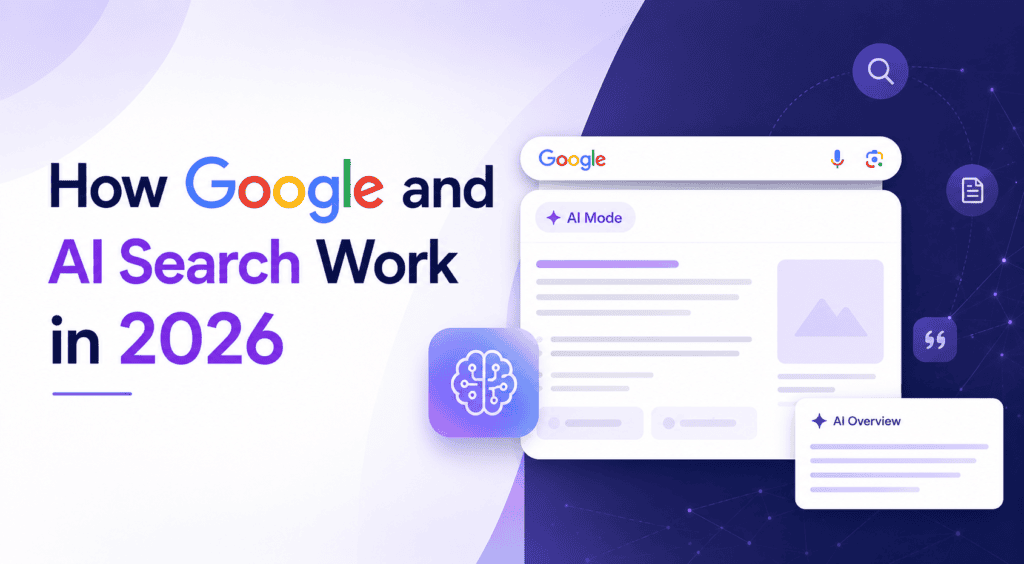
How Does Google Search Work?
Google Search can be understood through several major stages.
| Stage | What happens |
| Discovery | Google discovers URLs through links, sitemaps and other sources |
| Crawling | Googlebot requests and processes pages |
| Rendering | Google processes JavaScript and the page as rendered |
| Indexing | Google analyzes and stores information about eligible pages |
| Understanding | Google interprets content, entities, topics and relationships |
| Retrieval | Relevant pages are selected from Google’s index |
| Ranking | Multiple ranking systems evaluate which results best satisfy the query |
| Search results | Relevant results and search features are presented to the user |
These stages are connected, but they are not the same thing.
A page can be discovered without being crawled, crawled without being indexed, or indexed without receiving meaningful rankings.
How Does Google Discover a Website?
Google first needs to know that a URL exists.
Common discovery sources include:
- Internal links
- External links
- XML sitemaps
- Previously known URLs
- Other Google discovery mechanisms
This is why website architecture matters.
If your homepage links to your important service pages and those pages connect to related content, Google has clearer pathways for discovering your website.
A sitemap can also help Google discover new or updated URLs, but submitting a sitemap does not guarantee that every URL will be crawled or indexed.
How Does Google Crawl a Website?
Crawling happens when Googlebot requests a URL and processes the response.
Google can encounter:
- HTML
- Text
- Images
- JavaScript
- CSS
- Links
- Structured data
- Canonical information
- Redirects
- HTTP status codes
Technical problems can interrupt this process.
For example, a page returning a 404 error is very different from a page returning a successful response. A page blocked from crawling is also different from a page that Google crawls but chooses not to index.
This is why technical SEO is part of search visibility rather than simply a performance exercise.
What Is the Difference Between Crawling and Indexing?
These two concepts are often confused.
| Process | Meaning |
| Crawling | Google accesses and processes a URL |
| Rendering | Google processes the page and its resources, including JavaScript where necessary |
| Indexing | Google processes information about the page and determines whether it should be stored and made eligible for search |
A page being indexed does not mean it will rank well.
It only means that Google has processed it sufficiently to potentially use it in search.
How Does Google Understand Website Content?
Modern Google Search does not rely only on exact keyword matching.
Google uses language understanding and machine learning systems to understand concepts, entities, relationships and the meaning behind queries and webpages.
For example, a page about:
“Knee Replacement Recovery”
may also contain concepts such as:
- orthopedic surgery
- rehabilitation
- physical therapy
- mobility
- pain management
- recovery timeline
Google can use the relationship between these concepts to understand the broader subject.
This is why repeating the exact keyword dozens of times is not a modern SEO strategy.
The page needs to clearly explain the topic.
How Does Google Understand Search Intent?
A search query represents more than words.
Google tries to understand what the user actually wants.
For example:
“SEO audit”
could mean the user wants:
- an SEO audit definition
- an SEO audit checklist
- an SEO audit tool
- an SEO audit service
- SEO audit pricing
The page that best matches the user’s intent has a stronger opportunity to rank.
This is why a page can target the correct keyword but still perform poorly.
The problem may not be the keyword.
It may be the answer.
How Does Google Rank Websites?
There is no single public Google ranking formula.
Google uses multiple automated ranking systems and signals designed to determine which results are relevant and useful for a particular query.
Some publicly documented areas include language understanding, neural matching, RankBrain, BERT, passage-related systems, link analysis, freshness systems, spam detection and systems designed to improve reliable information.
A useful way to think about ranking is through signal categories.
| Signal area | What it helps determine |
| Relevance | Does the page address the query? |
| Content quality | Is the information useful and valuable? |
| Search intent | Does the page satisfy what the user wants? |
| Links | What relationships and authority signals exist across the web? |
| Freshness | Does the query require current information? |
| Context | Does language, location or other context affect relevance? |
| Spam systems | Does the website violate search quality or spam policies? |
There is no universal weighting that applies equally to every search.
The importance of different signals can vary depending on the query.
Why Can a Page Be Indexed but Still Get Zero Clicks?
Indexing is only one part of visibility.
A page may be indexed but receive little traffic because:
- it ranks too low
- it targets low-demand queries
- the content does not match search intent
- competitors are stronger
- the title does not attract clicks
- the topic is highly competitive
- the page has weak relevance
This distinction is important when diagnosing a new website.
Indexed does not mean competitive.
How AI Search Works Differently
Traditional search mainly answers:
Which webpages should I show?
AI search can answer:
What information should I retrieve and use to answer this question?
A simplified AI search workflow looks like this:
| Stage | What happens |
| Question understanding | The system interprets the user’s question and intent |
| Query expansion | Complex questions may be broken into related information needs |
| Retrieval | Relevant webpages or sources are found |
| Source evaluation | Potential sources are assessed for relevance and usefulness |
| Information extraction | Relevant facts or passages are identified |
| Answer generation | Information is synthesized into a response |
| Citations | Supporting sources may be linked or cited |
Different AI search systems use different technologies and ranking mechanisms. Their exact internal algorithms are not completely public.
Therefore, there is no universal “AI ranking score.”
How Does AI Search Understand a Question?
AI systems can process natural language and conversational context.
Compare:
Traditional keyword
with:
Complex question
Why are my ecommerce product pages indexed by Google but not appearing in AI answers?
The second question contains multiple concepts:
- ecommerce
- product pages
- indexing
- AI search
- visibility
- troubleshooting
The system can use this context to determine what information needs to be retrieved.
This is one reason question-based content is increasingly valuable.
How Does AI Search Find Websites?
For a complex question, an AI search system may need information from several sources.
For example:
How can a business improve its visibility in AI search?
Relevant information could involve:
- technical accessibility
- website content
- entities
- structured data
- search intent
- authority
- citations
- content quality
Some AI search experiences can perform multiple related searches to gather information before generating an answer.
The important concept is:
AI search is not necessarily selecting one webpage and copying it.
It can retrieve information from multiple sources and synthesize an answer.
Why Does AI Cite One Website Instead of Another?
There is no guaranteed formula, but several practical characteristics can make a source more useful.
| Factor | Why it matters |
| Relevance | The source directly answers the question |
| Clarity | Important information is easy to understand |
| Specificity | The page provides concrete information |
| Authority | The source has credible signals |
| Entity clarity | It is clear who created the information |
| Freshness | Information is current when freshness matters |
| Accessibility | The content can be discovered and processed |
| Evidence | Claims can be supported or verified |
This is where GEO becomes relevant.
What Is GEO?
Generative Engine Optimization, or GEO, is the practice of improving a website’s ability to be discovered, understood, retrieved and represented in AI-powered search experiences.
GEO does not replace SEO.
It builds on many of the same foundations.
A practical GEO framework looks like this:
| GEO layer | Objective |
| Accessibility | Make important content accessible to crawlers |
| Discoverability | Make important pages easy to find |
| Extractability | Present information clearly |
| Entity clarity | Clearly communicate who you are and what you do |
| Semantic context | Connect related topics and concepts |
| Evidence | Support important claims with reliable information |
| Authority | Build relevant recognition across the web |
| Retrieval relevance | Answer questions users actually ask |
| Citation potential | Create information worth referencing |
The goal is not to manipulate an AI system into mentioning a brand.
The goal is to become a useful and credible source for questions related to your expertise.
Google SEO vs AI Search: What Is the Difference?
| Google Search | AI Search |
| Returns ranked results | Generates an answer |
| Focuses heavily on query-result relevance | Retrieves information for a conversational question |
| Ranking position is a major visibility metric | Citations and mentions can become visibility signals |
| Users usually choose a result | Users may receive synthesized information first |
| Search results can contain many pages | One answer can combine multiple sources |
The two systems overlap, but they are not identical.
Ranking well on Google does not guarantee an AI citation.
Likewise, being cited by an AI system does not mean your website ranks first for every related Google query.
Why Is My Website Not Visible in Google or AI Search?
Poor visibility can come from several different problems.
| Problem | Possible cause |
| Not discovered | Weak internal links or limited discovery |
| Not crawled | Technical or crawl-related problems |
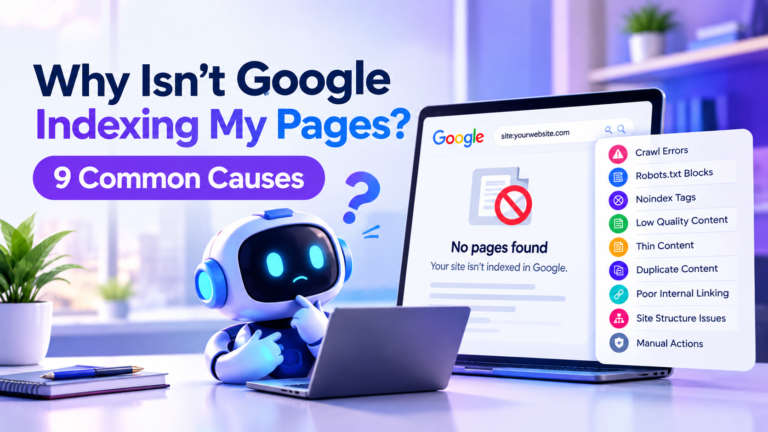
| Not indexed | Noindex, duplication or other indexing issues |
| Indexed but not ranking | Weak relevance, intent, quality or authority |
| Ranking but no clicks | Poor SERP appeal or weak query targeting |
| Google visibility but weak AI visibility | Limited source relevance, entity clarity or AI retrieval coverage |
| Competitors dominate | Stronger content, authority or overall search relevance |
This is why simply publishing more articles is not always the answer.
You first need to identify which stage is failing.
The Complete Search Visibility Framework
A modern website should be optimized across the full journey.
| Stage | Primary objective |
| Technical SEO | Make the website accessible |
| Crawling | Help search systems discover content |
| Indexing | Ensure valuable pages can enter the index |
| Content | Answer real user problems |
| Semantic SEO | Establish relationships between topics |
| Internal linking | Connect related information |
| Authority | Build credible external signals |
| SEO | Improve traditional search visibility |
| AEO | Structure content around direct questions and answers |
| GEO | Improve AI retrieval and citation potential |
This creates a much more complete approach than focusing only on keywords.
Want More Visibility in Google and AI Search?
At Pizles, we help businesses improve their visibility with SEO, GEO, AEO and AI SEO.
If your website is not getting the rankings, traffic or AI visibility you expect, we can find what’s holding it back and show you what to fix.
Get your Free SEO & AI Visibility Audit from Pizles today.
Frequently Asked Questions
How does Google rank a website in 2026?
Google uses multiple automated ranking systems and signals to determine which pages are relevant and useful for a particular query. These can involve content relevance, search intent, links, freshness where appropriate, quality, context and spam-related systems. Google does not publish one universal ranking formula that explains every result.
Why is my website indexed but not ranking?
Indexing only means Google has processed your page and may use it in search. It does not mean the page is competitive. Your page may have weak relevance, poor search-intent alignment, insufficient authority, strong competition or content that does not provide the best answer for the query.
How does Google understand what my website is about?
Google analyzes the content and context of webpages using language understanding and other systems. It can interpret words, concepts, entities and relationships between topics. Clear headings, useful content, descriptive links and a logical site structure can make your website easier to understand.
Does Google rank pages based only on keywords?
No. Keywords help communicate relevance, but modern Google Search uses much broader language and information-understanding systems. A page can rank for related searches without repeating an exact keyword because Google can understand concepts and relationships.
How does AI search decide which website to cite?
AI search systems retrieve potential sources and determine which information is useful for answering a question. Relevance, clarity, authority, context, accessibility and source quality can all contribute, but the exact mechanisms differ between AI platforms and are not fully public.
Can a website rank on Google but not appear in AI answers?
Yes. Traditional search rankings and AI source selection are different processes. A page can rank well for a search query but not be selected for a particular AI response. AI systems may also retrieve information from sources that are not the top traditional result for the user’s question.
Does GEO replace SEO?
No. GEO should be considered an extension of modern search optimization. Technical SEO, content quality, indexing, internal linking, entities and authority remain important because AI systems also depend on accessible and understandable information.
Does schema guarantee AI visibility?
No. Structured data can help search engines understand content when implemented correctly, but it does not guarantee rankings or AI citations. Schema should support a clear website structure rather than be treated as an AI ranking shortcut.
What should I fix first if my new website has zero traffic?
Start with technical accessibility and indexing. Then investigate whether important pages are indexed, whether they target realistic search intent, whether the site has enough topical coverage, and whether competitors have stronger content and authority. Publishing more content before identifying the underlying problem may not solve the issue.
What is the most important factor for Google and AI search?
There is no single factor that guarantees visibility. A strong foundation combines technical accessibility, useful content, clear search intent, semantic relevance, internal linking, entity clarity and credible authority. For AI search specifically, information also needs to be clear and useful enough to retrieve and potentially cite.