
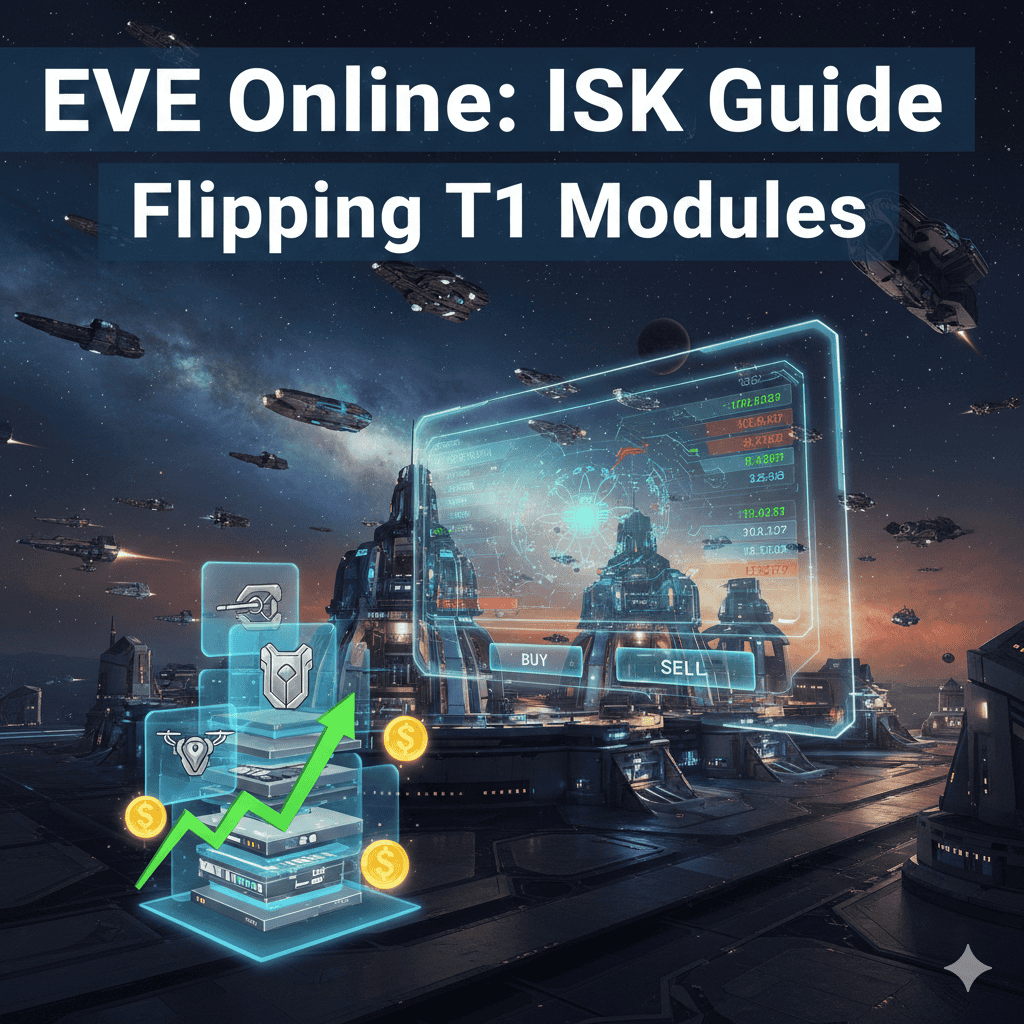
Welcome to EVE Online, the expansive, immersive, and challenging space RPG. Whether you’re a new Capsuleer finishing the career agents or a returning player seeking a simple income stream, ISK—the in-game currency—is essential.
Mining, exploration, and high-risk PvP ventures are not the only ways to earn ISK. One of the easiest, most reliable methods for beginners is market flipping, particularly with Tech 1 (T1) modules. This guide will show you how to turn these modules into steady ISK, using a low-risk, station-bound strategy.
Understanding Market Flipping in EVE Online
The concept of market flipping is simple: buy an item at a lower price and sell it at a higher price. The profit comes from the difference between your purchase price and the sale price.
In EVE Online, prices vary widely because some players want instant liquidity, selling items below market value, while others are willing to pay a premium to buy quickly. This price disparity is where traders make ISK.
Why Flip T1 Modules?
T1 modules are the perfect choice for beginner traders:
- High Volume: Every ship fit requires T1 modules. This ensures constant demand.
- Low Barrier to Entry: Many T1 modules cost only a few thousand to a few million ISK, making them accessible for new players.
- Moderate Competition: While Jita is extremely competitive, secondary trade hubs offer opportunities with higher margins and slower-paced markets.
Setting Up Your Trading Operation
Before you start flipping, set up a proper trading environment and train essential skills.
Step 1: Choose Your Trading Hub
While Jita is the largest trade hub, competition can be intense. Beginners benefit from quieter markets with steady demand. Recommended hubs include:
- Dodixie
- Amarr
- Rens
- Hek
Alternatively, if you frequently run missions in a specific system, you can focus on local demand, buying and selling T1 modules where you spend most of your gameplay time.

Step 2: Train Essential Trading Skills
Even though you can flip T1 modules without specialized skills, investing in a few will increase your profit and efficiency. These skills are beginner-friendly and suitable for Alpha accounts:
- Accounting – Reduces the sales tax when selling items, directly increasing profit.
- Broker Relations – Reduces fees when placing or updating orders, saving ISK over time.
- Trade – Increases the number of active sell orders, allowing simultaneous flips.
- Retail – Expands the range of your sell orders, letting you sell to multiple regions.
Focus on Accounting and Broker Relations to level III or IV first. The return on investment is almost immediate.
The Strategy: Finding High-Profit T1 Modules
Not all T1 modules are profitable. Focus on items with high turnover and healthy spreads.
The Rule of 10–15% Spread
To make a consistent profit, target items where the difference between the lowest sell order and the highest buy order is at least 10–15%, after fees.
Example:
- Lowest Sell Order: 1,000,000 ISK
- Highest Buy Order: 800,000 ISK
- Spread: 200,000 ISK (25%) – this is a solid profit margin.
Avoid items with very small spreads (e.g., 2%), as fees and constant order updates can consume all profits.
Ideal T1 Modules for Beginners
Focus on modules that are in constant demand:
- Weapons: Small, Medium, and Large T1 Lasers, Autocannons, and Hybrid Blasters.
- Warp Core Stabilizers: Essential for hauling and escaping.
- Afterburners and Microwarpdrives: T1 propulsion modules are always in demand.
- Shield and Armor Repairers: Small and medium modules used in PvE and PvP.
- Drones: T1 light and medium drones like Hobgoblins and Warriors are constantly replaced.
Tip: Check the market’s “Last 30 Days” volume. High-volume items sell faster, even with a smaller spread.
Mastering the .01 ISK Game
The “.01 ISK game” is how you maximize your orders.
- Buy Orders: Undercut the current highest buy order by 0.01 ISK to ensure your order fills first.
- Sell Orders: Undercut the lowest sell order by 0.01 ISK so your item sells before others.
This method ensures you remain at the top of the queue, giving you the fastest turnover.
Daily Trading Workflow
Flipping T1 modules can be done with minimal time commitment.
Morning Check – Buy Phase
- Review all active buy orders. Update undercut orders by 0.01 ISK.
- Identify 2–3 new high-margin T1 modules and place buy orders.
Mid-Day Check – Haul Phase
- Collect completed buy orders. Your cargo hold will have the purchased modules.
- Decide if selling immediately is profitable or if reprocessing into minerals is better.
- List modules for sale, undercutting existing sell orders by 0.01 ISK.
Evening Check – Sell Phase
- Review completed sell orders and collect ISK.
- Check remaining sell orders for undercuts, updating only high-volume items.
- Reinvest profits into higher-volume T1 modules or slightly more expensive items, like best scan res ships EVE Online modules.
Advanced Strategies for Scalability
Once you master basic T1 flipping, expand your operations:
Regional Arbitrage
Move items between regions to profit from price differences:
- Buy modules cheaply in secondary hubs like Rens.
- Haul them to Amarr or Dodixie, where demand and prices are higher.
This involves traveling through potentially dangerous space but can yield massive profits.
Long-Term Investment
Keep an eye on EVE Online gameplay news and updates:
- New ships or rebalancing events often increase demand for certain modules.
- Purchase items before the patch and sell afterward for maximum profit.
Using External Tools
- EVE Marketer / EVE Central – Real-time market data across all hubs.
- Dotlan – Helps identify secondary trade hubs and profitable systems for niche items.
Conclusion
Flipping T1 modules is not glamorous, but it’s one of the safest and most consistent ways to earn ISK in EVE Online. It requires patience, observation, and understanding market trends—the real PvP of trading.
Start small, focus on high-volume modules, master the 0.01 ISK game, and gradually scale your operations. Soon, you’ll have enough ISK to trade T2 modules, commodities, or even fund large fleets of ships.
FAQs About Flipping T1 Modules in EVE Online
1. What is market flipping in EVE Online?
Market flipping involves buying items at a lower price and selling them at a higher price to earn the profit margin.
2. Why should beginners start with T1 modules?
T1 modules are cheap, high-volume, and in constant demand, making them perfect for low-risk trading.
3. Which trading hubs are best for beginners?
Dodixie, Amarr, Rens, and Hek are recommended. These hubs have moderate competition and sufficient volume.
4. What skills are essential for trading in EVE Online?
Accounting, Broker Relations, Trade, and Retail are essential for maximizing profits and efficiency.
5. How do I calculate the best profit margin?
Focus on modules with a 10–15% spread between the highest buy order and the lowest sell order after fees.
6. What is the “.01 ISK game”?
It’s a method where you undercut the current buy or sell orders by 0.01 ISK to remain at the top of the queue.
7. How often should I check my market orders?
A simple daily routine of morning, mid-day, and evening checks is sufficient for T1 flipping.
8. Can I make ISK using T1 flipping without leaving a station?
Yes. This strategy is low-risk and station-bound, requiring no travel in dangerous space.
9. Are there tools to improve flipping efficiency?
Yes, websites like EVE Marketer, EVE Central, and Dotlan provide market data and help find arbitrage opportunities.
10. When should I move to T2 or higher modules?
Once you consistently earn ISK flipping T1 modules and have capital for higher-value items, you can scale to T2 modules, commodities, or large fleets.